Understood: Support ADHD Kids
- 4.4
- Rating
- 50.00K
- Installs
- Free
- Price

 Analysis by App-foxy
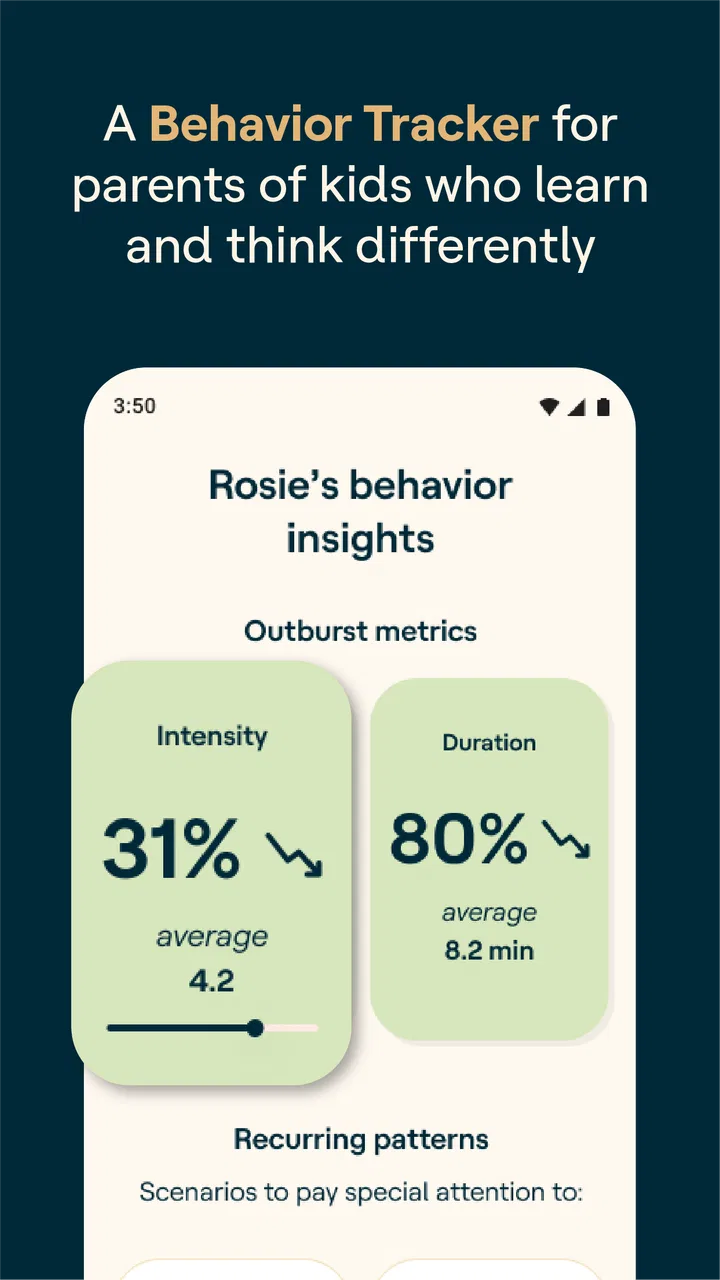
Parenting a child with ADHD often involves trying to see patterns in behavior that can disappear inside the rush of school mornings, homework, meals, and bedtime. Understood: Support ADHD Kids takes a practical approach to that problem: it gives parents a behavior-tracking tool developed by psychologists, rather than asking them to rely only on memory or general impressions. After spending time with it, my view is clear: this is most useful when you want a calmer way to notice what happens before and after difficult moments, but it works best as a support for conversations and routines, not as a diagnosis or a complete parenting program.
The app is free, which makes it easier to try without turning a family decision into another subscription commitment. It comes from Understood for All, Inc., an organization focused on helping people with learning and thinking differences. The app sits in the parenting category, carries a Teen content rating, and is available for devices running Android or iOS 10 and later. Its current version is 2.20, and its presence on the stores is established enough to have more than fifty thousand installs, with a 4.4 average from a little over five hundred ratings.
What the tracker gets right in everyday family life
The strongest part of the experience is its focus. It does not try to become a general child diary, a school portal, a medical record, and a reward chart all at once. Its purpose is narrower: help parents record behavior connected with ADHD and look at it with more structure. That narrow purpose matters because a tool can be easier to use when it asks you to observe one practical question instead of documenting every detail of family life.
You May Also Like

 Blood Strike: 2.5 Anniversary
Blood Strike’s Loadouts Turn Every Drop Into a Tactical Gamble
A close look at Blood Strike’s custom loadouts: how fast access to signature weapons reshapes its battle royale rhythm, rewards preparation, and narrows the gap between fights.

 Pandora - Music & Podcasts
Pandora’s Music Is Easy to Start, but Harder to Recover
Pandora’s strength is its low-effort path from a seed to a station. Its weak spot is how much confidence it asks you to place in connection, setup, and quiet recovery.

 8 Ball Pool
 Is Built on Rivalries, Rematches, and Routine
A close look at the rivalries, rematches, shared routines, and unanswered safety questions that turn a quick pool match into a persistent mobile community.

 Samsung Music
’s Quiet Strength Is Playing What You Already Own
Its reach comes less from spectacle than from dependable access to a personal library. That simplicity is both the app’s strongest retention engine and its ceiling.

 AccuWeather: Weather Radar
AccuWeather Review: A Quick, Clear Forecast for Everyday Decisions
For everyday plans, the best forecast is the one you can understand quickly. AccuWeather makes rain timing, radar, and local conditions easy to act on, with a few trade-offs.

 Hill Climb Racing
Why Hill Climb Racing Still Turns Crashes Into One More Run
A tiny car, a bumpy hill and one more upgrade: Hill Climb Racing keeps resurfacing because its simple chaos makes every near-miss feel personal.
More From Our News Desk



I found the basic idea especially valuable after a hard day. A parent may remember that a child “was impossible” from breakfast onward, but that summary can hide several different situations: perhaps the morning went smoothly until the usual change of activity, or perhaps the problem was strongest after poor sleep, a skipped meal, or an unusually demanding school day. Tracking can turn that broad frustration into something more specific. Specific observations are more useful when deciding what to change next.
That does not mean every entry will reveal a dramatic pattern. In fact, the app is more helpful when used with modest expectations. A few observations are not enough to prove that one cause always leads to one behavior. What they can do is give you better questions. Is the difficult moment linked to transitions? Does homework become harder after a long afternoon? Does a visual warning help? Is a request more successful when it is short and concrete? Those are manageable questions for a parent, and they are more actionable than simply labeling a day good or bad.
My favorite way to use a behavior tracker like this is to choose one target at a time. For example, instead of recording every disagreement, I would focus for a week on starting the bedtime routine. That keeps the notes from becoming a second job and makes the results easier to interpret. If the target is too broad, the record becomes vague; if it is narrow enough to observe, the parent can compare similar moments and decide whether a small routine change is worth keeping.
There is also a useful emotional benefit. Writing down what happened can create a pause between the event and the judgment about it. That pause does not make challenging behavior disappear, but it can help a parent describe the situation more fairly. “The transition took three reminders and ended in an argument” is more useful than “nothing works.” The first statement can lead to an experiment; the second usually leads only to exhaustion.
A workflow that makes the information more useful
I would not open the app only after a crisis. The better workflow is to decide in advance what you are watching, record brief observations close to the event, and review them when everyone is calm. That order prevents the tracker from becoming a place to vent. It also reduces the risk of remembering only the most dramatic moments.
A simple routine could look like this:
Pick one behavior that affects daily life, such as beginning homework or leaving the house.
Notice the setting and what happened immediately before it, without trying to explain the cause too quickly.
Record the response and what happened afterward, keeping the wording neutral.
Review several similar situations together rather than reacting to one difficult entry.
Choose one small adjustment and observe whether the next comparable situation changes.
The non-obvious advantage of this approach is that it separates observation from intervention. Parents often change several things at once because they are desperate for improvement: earlier bedtime, different instructions, a new reward, less screen time, and a different homework location. If the child improves, it is impossible to know which change helped. A focused tracker encourages a slower approach. That may feel less satisfying in the moment, but it creates clearer learning for the family.
Another useful habit is to include successful moments, not only problems. If a child begins a task independently, handles a transition with one reminder, or recovers more quickly than usual, that is worth noting. Positive examples show what conditions may already be working. They also protect the record from becoming a catalogue of failure, which can affect how a parent sees the child over time.
Where it can help beyond the home
The app can be particularly useful before a conversation with a pediatrician, therapist, teacher, or school support team. A parent who arrives with a few concrete examples can explain the difficulty more clearly than someone who has only a general sense that things are getting worse. The record may help identify when the behavior occurs, how often it interrupts routines, and what the family has already tried.
I would still treat those notes as a conversation aid rather than a clinical report. A behavior tracker cannot establish whether ADHD is present, determine the right treatment, or explain every behavior. It can help a parent describe lived experience in a way that another adult can understand. That distinction is important, especially for families who might otherwise expect an app to provide answers that require professional assessment.
It also has value for co-parents and other caregivers. Adults can remember the same event differently, particularly when one person handles mornings and another handles evenings. A shared method of observing behavior can reduce arguments about whose impression is correct. The goal should not be to build a case against the child or another caregiver. The goal is to notice what the child needs in different contexts.
A realistic example would be a nine-year-old who regularly refuses homework. Rather than recording “homework was a disaster,” I would note whether the assignment began immediately after school, whether the child had eaten, how the task was presented, and whether the first step was clear. After several comparable days, the parent might discover that the hardest part is not the work itself but the transition into it. That insight could lead to a short decompression period, a snack, or a smaller first task. The app does not prescribe that solution; its value is helping the family investigate the situation more carefully.
Limitations parents should understand before relying on it
The same focused design that makes the app approachable can make it feel limited to parents seeking a complete toolkit. If you want detailed educational content, medication reminders, school communication, a family calendar, or an elaborate reward system, this is not the app I would choose as the main hub. Its strength is behavior observation, so it should not be judged as though it were designed to manage every part of ADHD care.
Tracking itself can also create friction. During a chaotic morning, the last thing a parent may want is another task on a phone. If recording becomes too detailed, the habit will probably fade. My advice is to keep entries short and define the purpose before starting. A tracker that is used briefly and consistently is more valuable than one that encourages ambitious notes for two days and then gets abandoned.
There is a second risk: overinterpreting patterns. ADHD behavior is affected by context, development, stress, sleep, learning demands, relationships, and many other factors. A repeated sequence can be a clue, but it is not proof of a single cause. Parents should resist turning the app into a scoring system for the child. The most constructive question is not “How bad was the behavior?” but “What was happening around it, and what support might make the next attempt easier?”
Privacy and family trust also deserve attention in everyday use. A child may feel watched if the phone appears immediately after every mistake. I would avoid recording in a way that humiliates the child or makes the tracker visible during conflict. When appropriate, explain that the purpose is to understand difficult situations and improve support, not to collect evidence for punishment. The tool is more likely to help when it sits behind a respectful conversation rather than replacing one.
The Teen content rating may also matter in a household where children use the same device. The rating does not change the app’s parenting purpose, but it is a reminder that parents should decide how and where it is used, especially if a child might open it independently. In practice, I would treat it as an adult-facing support tool and keep the focus on the parent’s observations and decisions.
Who will benefit most from this app?
I would recommend it first to parents who feel that their observations are scattered. If you regularly tell yourself, “This keeps happening, but I cannot explain when or why,” a dedicated tracker can provide useful structure. It is also a good fit for a parent preparing for a professional appointment or trying to make a home routine more predictable without immediately adopting a complicated behavior program.
It may be especially helpful when different adults see different sides of the child. A teacher may report difficulty starting work while a parent sees problems with transitions at home. Recording the setting can help everyone avoid assuming that one environment tells the whole story. The app is not a substitute for communication with school staff, but it can make that communication more concrete.
I would be more cautious about recommending it to someone who wants instant advice after every incident. This is not a magic button that tells you what to do next. It rewards patience, consistency, and a willingness to review patterns. Parents who dislike logging or who already have a reliable system may gain little from adding another tool.
It is also not the right choice for a family looking for diagnosis or treatment decisions. If behavior is creating safety concerns, seriously disrupting school or home life, or causing distress that the family cannot manage, professional support should come first. The app can help organize examples for that conversation, but it should not delay it.
How it compares with familiar alternatives
The usual alternative is a paper notebook or a note-taking app. Those options are flexible and may be faster for a parent who wants free-form detail. Their weakness is that notes can become inconsistent: one day includes triggers, another includes only the outcome, and later it is hard to compare situations. A purpose-built behavior tracker has an advantage when you want a repeatable structure rather than a diary.
A generic habit tracker is another possibility. It may be excellent for checking whether a child completed a task, but completion alone does not explain what made the task difficult. This app is better suited to looking at the behavior in context. On the other hand, a generic tracker may be preferable if your goal is simply monitoring routines for several family members rather than understanding ADHD-related behavior.
Reward charts and visual schedules serve a different purpose. They can make expectations visible and motivate a child in the moment, while a behavior tracker helps the parent reflect on what is happening over time. I would not use one as a replacement for the other. A family might use a simple visual routine with the child and use this app privately to notice which parts of that routine need adjustment.
Professional care remains the stronger option when interpretation is complex. A clinician can consider development, learning differences, anxiety, sleep, medication, and family circumstances in a way an app cannot. The sensible comparison is therefore not “app versus professional,” but “unstructured memory versus organized observations that support better professional conversations.” In that role, this tool makes more sense.
My final recommendation
Understood: Support ADHD Kids is a focused, free parenting app with a useful thesis: careful observation can make everyday ADHD challenges easier to discuss and address. I appreciate that it was developed by psychologists and that it does not need to pretend to be an all-purpose family management system. Its best contribution is modest but meaningful—helping a parent move from frustration toward a clearer description of what happens, when it happens, and what might be worth trying.
The trade-off is that the app asks for consistency while offering no shortcut around the work of parenting. It will not diagnose a child, settle disagreements between caregivers, or guarantee that a routine improves. It can also feel like extra administration if you record too much or use it during every stressful moment. Used selectively, however, it can become a practical reflection tool rather than another source of pressure.
My recommendation is strongest for parents who want to investigate one recurring behavior, prepare for a professional discussion, or bring more consistency to observations across caregivers. I would skip it if you are looking for a full ADHD treatment planner, an educational resource library, or a child-facing reward game. For the right audience, the real strength is not collecting more information; it is turning ordinary family moments into observations that can guide a calmer next step.
FAQs for Understood: Support ADHD Kids
01What is Understood: Support ADHD Kids?
Understood: Support ADHD Kids is an educational and support-focused app designed to help parents, caregivers, and educators better understand children with ADHD and related learning or thinking differences. It provides practical information, guidance, and tools that can make everyday routines, communication, schoolwork, and emotional support easier to manage.
02Who can benefit from using Understood: Support ADHD Kids?
The app is mainly intended for parents and caregivers of children with ADHD, but teachers, tutors, school staff, and other family members may also find it useful. It can help adults recognize common challenges, discover supportive strategies, and approach behavior or learning difficulties with greater patience and understanding. It is not limited to one specific age group.
03Does Understood: Support ADHD Kids diagnose or treat ADHD?
No. Understood: Support ADHD Kids should not be considered a diagnostic or medical treatment tool. The information and activities are intended for education, awareness, and everyday support only. If you suspect that a child has ADHD or another developmental, emotional, or learning condition, you should speak with a qualified healthcare professional or school specialist for an appropriate evaluation.
04What kind of information and tools does the app provide?
The app focuses on practical support rather than simply presenting general definitions. Depending on the available content and version, users may find explanations of ADHD-related behaviors, suggestions for routines and organization, communication advice, school-support ideas, and guidance for handling common challenges. The recommendations are intended to help adults create more predictable and encouraging environments for children.
05Is Understood: Support ADHD Kids free to download, and does it require internet access?
The download and available features may vary depending on whether you use the Android or iOS version, as well as the app’s current release. Some content may be available at no cost, while additional resources or services could have separate requirements. An internet connection may be needed for downloading content, updates, or certain online features, so check the store listing before installing.
Pros
- Practical tools help children understand attention and organization challenges.
- Visual activities make difficult concepts easier for younger users to follow.
- Content can support conversations between children
- parents
- and teachers.
- Useful for building routines around schoolwork
- tasks
- and daily responsibilities.
- Designed with an encouraging tone that avoids making ADHD feel like a personal failure.
Cons
- Some guidance may feel too general for children with complex support needs.
- Parents may need to explain activities to younger children.
- The app cannot replace professional assessment
- therapy
- or medical advice.
- Progress may depend heavily on regular use and adult involvement.
- Certain features or content may require payment or an ongoing subscription.

Understood: Support ADHD Kids
Gallery